An honest reckoning with ‘dishes-math’ — and why that innocent little stack always costs you more than it should.
This is (mostly) about hand-washing dishes, but it can apply equally to those who use a dishwasher, and can’t be bothered to rinse the dishes, pack them into the dishwasher, and run it and empty it regularly.
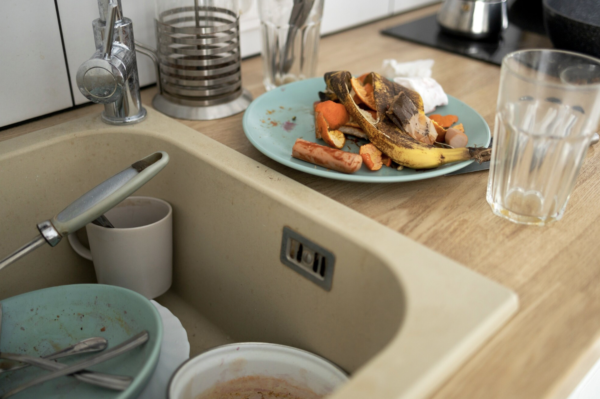
There is a particular kind of lie we tell ourselves in the kitchen. It goes like this: “It’s just a few dishes. I’ll do them later.” It is a gentle, harmless-sounding lie – the kind that sits quietly on the counter, growing…
At Simple Slow Home believe in slowing down, and in resisting the frantic pace that modern life encourages us to partake in, but there is one place where delay is not slow living – it is simply delay. And it will cost you. Exponentially!
This is ‘dishes-math’, and once you understand it, you will never look at a cereal bowl the same way again.
A dish washed immediately takes 45 seconds. A dish left overnight can take 8 minutes, a scouring pad, and a quiet private rage.
The Multiplier Effect
The fundamental principle of ‘dishes math’ is this: the time spent on dishes does not grow linearly with delay – it compounds. There are two reasons for this.
Each hour a dish sits, the effort required to clean it increases by a factor that would make a mortgage broker wince.
Consider the humble dinner plate… Rinsed immediately after eating, it surrenders under warm water in under a minute; but if it’s left for two hours, the sauce has bonded to the ceramic at a molecular level. Left overnight, you are now in a geological event – the sauce has become sediment – a stratum of your bad choices – and it will require soaking, scrubbing, and a certain amount of character-building.
The Compounding Effect
This is what happens when a dish sits in the sink for a period of time:
0 – 15 min: This is the rinse era. A casual pass under water, you could do it one-handed. This is the golden window.
15 – 2 hrs: This is when you’ll find soap required. Still manageable. A brief scrub with a sponge – minor inconvenience only.
2 – 12 hrs: At this point, you’ll find that needs change. Soaking commences. The dish must now wait again – for you to fill the sink with hot water, and for the water to negotiate with the food. You have added a whole extra step.
12 – 24 hrs: this one is known as the crust phase. Scouring pad territory. The dish has developed opinions. You will need to apply meaningful physical effort.
24 hrs+: Archaeological conditions. The food has entered a new state of matter. You may need to boil water, use baking soda, and make peace with certain life decisions.
The actual math
If we graphed the effort required to clean a dish against the time elapsed since the meal, we do not get a gentle upward slope. we get something far more alarming – a curve that starts almost flat and then bends sharply upward, like compound interest working in reverse for your benefit.
A pasta bowl left for 12 hours requires roughly 57× more effort than one washed immediately.
The curve does flatten – eventually – but only because you have reached the ceiling of what effort can achieve. At that point, the dish may simply not come clean at all, and you might well now be shopping for a new pot.
So this is basically how it works out: – wash it immediately – 45 seconds – in around 1 hour – about 3 minutes – 4 hours? – around 8 minutes – overnight and it can ramp up to somewhere close to 18 minutes for a well-baked pot – and if you’re leaving if for a couple of days…. well, you’re looking at 40+ minutes and a pile of regret.
The second – even more important variable: volume
Dishes-math has a second, crueller dimension. It is not just that each individual dish gets harder to clean over time – it is that dishes reproduce in your absence.
You leave three plates beside the sink. You return to three plates plus the pan you used for lunch, the glass from the afternoon, the cutting board, two mugs, and somehow – inexplicably – a crusty spatula that you not only have no memory of using, but didn’t even know you owned!
This is because a kitchen with existing dirty dishes has a gravitational pull.
A clean counter repels clutter. A bench-top already holding a stack of yesterdays bowls offers no resistance to todays coffee mug. The pile creates a culture of permission. It says: we’re already behind, what’s one more?
A cluttered kitchen is not a state of being – it is a permission structure, and it will govern every meal you cook in it.
The hidden tax: the mental load
The final variable in dishes-math is the one that never appears on any chart. It is the ongoing cost of simply knowing the dishes are there.
They sit in your peripheral vision. They surface in your thoughts when you wake up. They quietly narrate your morning – not loudly, but steadily. A low, persistent hum of unfinished business…
Research into what psychologists call the ‘Zeigarnik Effect‘ tells us that the mind continues to process incomplete tasks, dedicating a small but real slice of mental bandwidth to them. Your undone dishes are renting space in your head, and they are paying nothing for it!
By contrast, a clean kitchen – with every surface clear and every dish returned to its home – produces a particular quiet in your mind that is worth far more than the minutes it cost to achieve it. This is the true economy of a small domestic act done promptly.
The slow home case for washing up now
Slow living is often misunderstood as a philosophy of deferral – as doing less, later, more gently. But at its best, it is something more precise: it is choosing where your time and attention go, so that you are truly present in the moments that matter.
The dishes, washed promptly after a meal, are still a slow act. You stand at the sink with your hands in warm water. You handle the vessels of a meal just shared, getting into a steady rhythm as you clean. You restore the kitchen to its resting state, ready for its next moment to shine. It can be a beautiful thing if you allow it to be!
Whereas the dishes left to wait are not slow living – they are a slow debt… The interest compounds, the effort multiplies, and by the time you finally face them, you are not washing dishes so much as doing penance.
The mathematics are unambiguous. The kindest, simplest, most generous thing you can do for your future self is to wash the bowl before you sit down.
✦ THE SIMPLE SLOW HOME RULE ✦ Before you leave the kitchen after any meal, the counter should be cleared, the dishes rinsed, and the sink empty. Not because tidiness is a virtue in itself – but because future-you deserves to walk into a kitchen that is still on your side.

Leave a Reply